




“Nowadays, if one talks about the 20th century, one is old. If one remembers it, one is older. If one listens to music from it, one is over the hill. If one actually likes music from it, one is six feet under. That is, one is hopelessly uncool, definitely not rad, definitely ringard. I guess, then, that I am ancient if I remember phone books, phone booths and like Berthe Sylva (February 7, 1885- May 24, 1941). So be it.
If one is looking for a blast from the past, the recorded legacy of the great Berthe Sylva, born Berthe Francine Ernestine Faquet, will delight any music lover’s ears, heart, and intellect. Of course, understanding French helps. Champion of la chanson réaliste, she made some 274 masters in all for the labels Pathé and Odéon. Active from 1908 to 1941, she was successful in her time.
(...)
What is most remarkable, at least to this listener, is the elegance and force of her voice. She is sentimental without being teary-eyed; realistic without being pessimistic; bleak without being tragic. She sings of misery without being miserable. “Les roses blanches” and all of her recordings recount a story and are chansons à texte, where the words carry the artistic weight and the music serves primarily as support. The listener is expected to pay attention to meaning, nuance, and narrative. She could sing equally convincingly about big things (death, misery) and small things (a toy, a cat). Those fluent in French will no doubt notice that Sylva’s French is impeccable: the use of the passé simple, the use of l’on and not on, the pronouncing of the final e in words such as blanches, mère, misère, dimanche, and so many others. A mezzo-soprano endowed with a strong and refined voice whose discrete vibrato gave it even more appeal, the woman was a mix of high class and working class, and rose above the stories she was singing, rather like a journalist or photographer covering the sad world around her, and not muddied by it. Her art allowed her to survive, and not partake in the grim era she lived in. She died at fifty-six of unknown causes.
Sylva’s records were never even distributed in the United States. They were too local, too foreign, too dark, too narrative, too vocally raw, too tied to Parisian social realities. Her music was a domestic French phenomenon, unlike Josephine Baker, Mistinguett, Édith Piaf and Maurice Chevalier, all of whom had international careers. As to whether her songs can be appreciated in the United States today, the answer is yes, and for many reasons. Her themes are timeless even if her style is vintage. Her voice has a rawness that feels modern. Chansons réalistes align with today’s taste for darker storytelling. And the digital era has made access to her recordings easier than ever before. She offers a window into a lost Paris, and last but not least, she appeals to people who care about those who are overlooked. Although Yip Harburg’s “Brother, Can You Spare a Dime?” in 1930 and Woody Guthrie’s “So Long, It’s Been Good to Know Yuh” in 1935 reflect life during the Great Depression, there is a polished universality to them compared to the heartbreaking world we hear in Sylva’s music.
(...)
The day has come for a Berthe Sylva revival in the non-Francophone world(...).”
By Lawrence SCHULMAN - ARSC JOURNAL

Related products
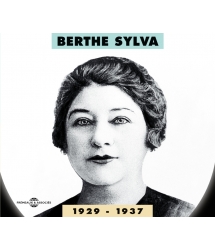
BERTHE SYLVA 1929-1937
€29.99
€19.95