
 |
Ray Charles - The Grand Master His Inspiration / His Influence 1944-1962 |
- Our Catalog
- Philosophy
- Philosophers of the 20th century and today
- History of Philosophy (PUF)
- Counter-History and Brief Encyclopedia by Michel Onfray
- The philosophical work explained by Luc Ferry
- Ancient thought
- Thinkers of yesterday as seen by the philosophers of today
- Historical philosophical texts interpreted by great actors
- History
- Books (in French)
- Social science
- Historical words
- Audiobooks & Literature
- Our Catalog
- Jazz
- Blues
- Rock - Country - Cajun
- French song
- World music
- Africa
- France
- Québec / Canada
- Hawaï
- West Indies
- Caribbean
- Cuba & Afro-cubain
- Mexico
- South America
- Tango
- Brazil
- Tzigane / Gypsy
- Fado / Portugal
- Flamenco / Spain
- Yiddish / Israel
- China
- Tibet / Nepal
- Asia
- Indian Ocean / Madagascar
- Japan
- Indonesia
- Oceania
- India
- Bangladesh
- USSR / Communist songs
- World music / Miscellaneous
- Classical music
- Composers - Movie Soundtracks
- Sounds of nature
- Our Catalog
- Youth
- Philosophy
- News
- How to order ?
- Receive the catalog
- Manifesto
- Dictionnary
My Shopping Cart
Total (tax incl.)
€0.00
Subtotal
Free
Shipping
Total product(s)
0 items
Shipping
Free
Selected for you
Roots of Soul - Remastered
RAY CHARLES, FATS DOMINO, NINA SIMONE
CD Version
€119.00
Digital Version
€79.95
Django Reinhardt - The 40 CDs from the Complete (Season 1, 2 and 3)
THE COMPLETE WORKS 1928-1938THE COMPLETE WORKS...
CD Version
€199.00
Digital Version
€149.95
Composers - The 6 CD sets offer
Michel Magne, Nino Rota, Georges Delerue, Maurice Jarre,...
CD Version
€134.00
Digital Version
€99.95
To discover Jazz (Includes an audiobook in French)
UN COURS PARTICULIER DE LAURENT CUGNYLA QUINTESSENCE DU JAZZ
CD Version
€89.00
Digital Version
€55.95
Selected for you
The leading publisher of musical heritage and the Sound Library



My Shopping Cart
Total (tax incl.)
€0.00
Subtotal
Free
Shipping
Total product(s)
0 items
Shipping
Free
Selected for you
Roots of Soul - Remastered
RAY CHARLES, FATS DOMINO, NINA SIMONE
CD Version
€119.00
Digital Version
€79.95
Django Reinhardt - The 40 CDs from the Complete (Season 1, 2 and 3)
THE COMPLETE WORKS 1928-1938THE COMPLETE WORKS...
CD Version
€199.00
Digital Version
€149.95
Composers - The 6 CD sets offer
Michel Magne, Nino Rota, Georges Delerue, Maurice Jarre,...
CD Version
€134.00
Digital Version
€99.95
To discover Jazz (Includes an audiobook in French)
UN COURS PARTICULIER DE LAURENT CUGNYLA QUINTESSENCE DU JAZZ
CD Version
€89.00
Digital Version
€55.95
Selected for you
- Our Catalog
- Philosophy
- Philosophers of the 20th century and today
- History of Philosophy (PUF)
- Counter-History and Brief Encyclopedia by Michel Onfray
- The philosophical work explained by Luc Ferry
- Ancient thought
- Thinkers of yesterday as seen by the philosophers of today
- Historical philosophical texts interpreted by great actors
- History
- Books (in French)
- Social science
- Historical words
- Audiobooks & Literature
- Our Catalog
- Jazz
- Blues
- Rock - Country - Cajun
- French song
- World music
- Africa
- France
- Québec / Canada
- Hawaï
- West Indies
- Caribbean
- Cuba & Afro-cubain
- Mexico
- South America
- Tango
- Brazil
- Tzigane / Gypsy
- Fado / Portugal
- Flamenco / Spain
- Yiddish / Israel
- China
- Tibet / Nepal
- Asia
- Indian Ocean / Madagascar
- Japan
- Indonesia
- Oceania
- India
- Bangladesh
- USSR / Communist songs
- World music / Miscellaneous
- Classical music
- Composers - Movie Soundtracks
- Sounds of nature
- Our Catalog
- Youth
- Philosophy
- News
- How to order ?
- Receive the catalog
- Manifesto
- Dictionnary
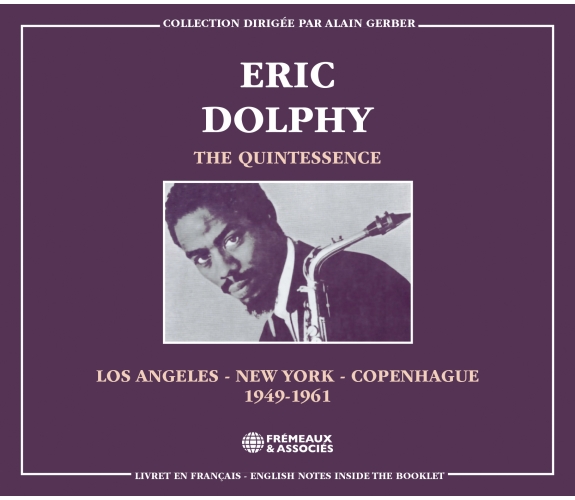
Eric Dolphy - The Quintessence
Ref.:
FA3074
Los Angeles - New York – Copenhague 1949-1961
Eric Dolphy
Ref.: FA3074
EAN : 3561302307428
Artistic Direction : Direction de collection : Alain Gerber, textes : François Billard & Jean-Paul Ricard. Discographie : Jean Buzelin.
Label : FREMEAUX & ASSOCIES
Total duration of the pack : 2 hours 29 minutes
Nbre. CD : 2
Select a version :
Thanks to this pack, you get a 20.00 %
discount or €9.99
This product is already in your shopping cart
A digital version of this product is already in your shopping cart
Shipped within 24 to 48 hours.
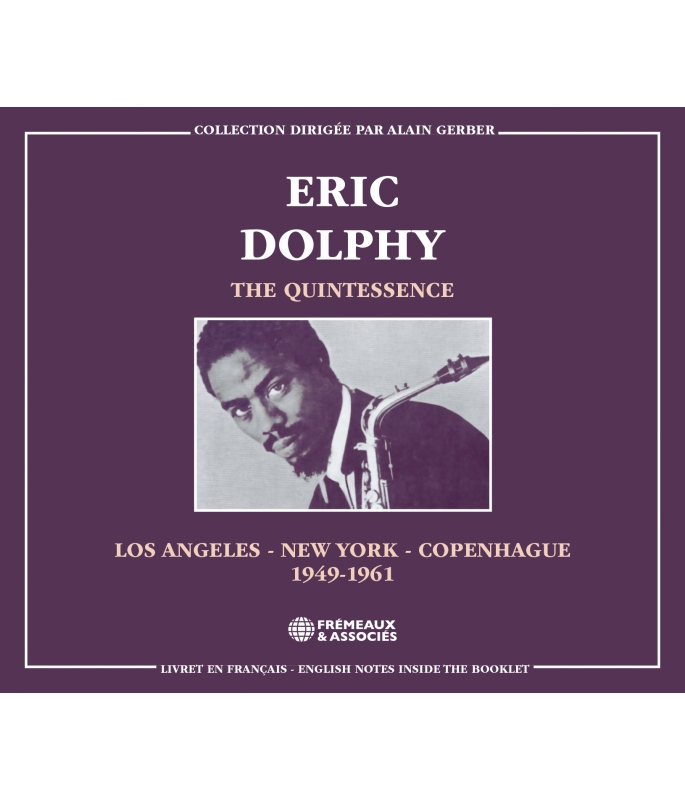
Los Angeles - New York – Copenhague 1949-1961
Presentation
Raised in the ranks of Californian bop, the gifted multi-instrumentalist Eric Dolphy brought a fresh breath into the most diverse contexts. A tireless “bridge-builder” toward a different realm of jazz—freer, and one he helped magnificently to open up—he stands as a profoundly sincere, principled, and generous artist. Here, he reveals the many facets of his art: the raw emotion of beauty laid bare.
Jean-Paul RICARD
CD 1 (1949-1960) : ROY PORTER & His 17 BEBOPPERS (Savoy 944) : GASSIN’ THE WIG -as. • CHICO HAMILTON QUINTET (Warner Bros WB1344) MISS MOVEMENT -as. • CHICO HAMILTON QUINTET (Sesac Repertory N2902) : LADY E -fl. • ERIC DOLPHY QUINTET (New Jazz NJ8236 & Prestige PR7382) : G.W. -as. 245 -as. LES -as. APRIL FOOL -fl. • OLIVER NELSON SEXTET (New Jazz NJ8243) ALTO-ITIS -as. • KEN McINTYRE/ERIC DOLPHY QUINTET (New Jazz NR8247) : CURTSY -as. LAUTIR -fl. • ERIC DOLPHY QUARTET (New Jazz NJ8252) : OUT THERE -as. SERENE -bcl. THE BARON -bcl. 17 WEST -fl. FEATHERS -as.
CD 2 (1960-1961) : ERIC DOLPHY/BOOKER LITTLE QUINTET (New Jazz NJ8270) : FAR CRY -as. MISS ANN -as. TENDERLY -as solo. • GEORGE RUSSELL SEXTET (Riverside R375) :‘ROUND MIDNIGHT -as. • RON CARTER/ERIC DOLPHY QUINTET (New Jazz NJ8265) : RALLY -bcl. SAUCER EYES -fl. • MAL WALDRON/ERIC DOLPHY/BOOKER ERVIN QUINTET (New Jazz NJ8269) : WARM CANTO -cl. WARP AND WOOF -as. • ERIC DOLPHY/BOOKER LITTLE QUINTET (Prestige PR7382 & New Jazz NJ8260) : GOD BLESS THE CHILD -bcl solo. FIRE WALTZ -as. • ERIC DOLPHY QUARTET (Prestige PR7366 & 7350) : IN THE BLUES Tk 3 -as. DON’T BLAME ME Tk 1 -fl. as = alto sax ; fl = flute ; bcl = bass clarinet ; cl = clarinet
DIRECTION COLLECTION : ALAIN GERBER, TEXTES : FRANÇOIS BILLARD & JEAN BUZELIN
To Discover
CHARLIE PARKER - QUINTESSENCE Vol 1
NEW YORK - HOLLYWOOD 1942 - 1947
CD Version
€29.99
Digital Version
€19.95
MILES DAVIS - QUINTESSENCE
1945 - 1951
CD Version
€29.99
Digital Version
€19.95
JOHN COLTRANE - THE QUINTESSENCE
NEW YORK CITY 1956-1962
CD Version
€29.99
Digital Version
€19.95
Benefit a discount
on this product
Sonny Criss - Livre + CD
Le livre + CD consacrés à Sonny Criss,...
CD Version
€49.99
Digital Version
€33.95
To Discover
CHARLIE PARKER - QUINTESSENCE Vol 1
NEW YORK - HOLLYWOOD 1942 - 1947
CD Version
€29.99
Digital Version
€19.95
MILES DAVIS - QUINTESSENCE
1945 - 1951
CD Version
€29.99
Digital Version
€19.95
JOHN COLTRANE - THE QUINTESSENCE
NEW YORK CITY 1956-1962
CD Version
€29.99
Digital Version
€19.95
Benefit a discount
on this product
Sonny Criss - Livre + CD
Le livre + CD consacrés à Sonny Criss, saxophoniste...
CD Version
€49.99
Digital Version
€33.95
Press
« Passionné de musique, et notamment de jazz et de rock, mais aussi et surtout galeriste et spécialiste de la peinture et de l’art contemporain et traditionnel (comme l’art africain, dont il présente d’intéressants témoignages dans sa galerie de Vincennes), Patrick Frémeaux — qui a signé récemment un essai consacré à l’écologie et publie aujourd’hui un ouvrage dédié à Pablo Picasso, avec une contribution de sa part et une autre de Paul Desalmand, Picasso par Picasso, Frémeaux/Pollen — a raison de se vanter d’être le plus important producteur discographique français de jazz, juste derrière le groupe multinational Universal.
Sa spécialité réside dans les rééditions anthologiques sur CD de documents déjà parus en LP. Dans ce domaine, il a su constituer un catalogue véritablement remarquable, comptant des centaines de titres magnifiques.
L’un des derniers titres qu’il a publiés est consacré au multi-instrumentiste afro-américain Eric Dolphy, l’un des principaux représentants du jazz californien. Dolphy fut saxophoniste et flûtiste, mais également un soliste original à la clarinette basse, et l’un des protagonistes d’une période, à cheval entre les années 1950 et 1960, fortement marquée par les expérimentations et les interactions avec la musique contemporaine européenne ; ce n’est d’ailleurs pas un hasard s’il fut, bien que brièvement, l’élève de Severino Gazzelloni lors des célèbres cours d’été de Darmstadt.
Un double CD très dense retrace chronologiquement toute la carrière, brève mais fulgurante, de cet extraordinaire et raffiné soliste et compositeur, capable de passer avec aisance d’atmosphères chambristes à des moments d’élan improvisé débridé, évoquant le modèle de Charlie Parker au saxophone alto, et de pièces fortement structurées à des épisodes inspirés par la plus grande liberté lexicale.
L’album de Frémeaux contient une sélection de ses meilleurs morceaux publiés entre 1949 et 1961 sur les labels Savoy, Warner, New Jazz, Prestige et Riverside. On y retrouve de véritables joyaux tels que G.W., 245, Far Cry et Fire Waltz, dans lesquels Dolphy apparaît avec différentes formations, comprenant notamment le pianiste Mal Waldron, le contrebassiste George Duvivier et le batteur Roy Haynes.
Les sessions originales furent enregistrées à Los Angeles, à New York, mais aussi à Copenhague, témoignant de l’excellent accueil que Dolphy reçut du public européen dans les années 1960. »
Par Luca CERCHIARI – L’OSSERVATORE
« Étoile filante du bop et du be-bop jusqu’aux confins du free-jazz, le saxophoniste alto, flûtiste et clarinettiste Eric Dolphy eut néanmoins le temps (avant sa disparition prématurée à Berlin-Ouest en 1934), de s’inscrire de manière indélébile dans l’histoire du jazz moderne. Sans évidemment prétendre à l’exhaustivité (rien qu’en tant que leader, sa discographie officielle, et en grande partie posthume, dépasse désormais la trentaine de références, et ses contributions en tant que sideman en dénombrent davantage encore), cette sélection subjective, opérée sous l’égide d’Alain Gerber (directeur de cette collection) et judicieusement commentée et annotée par les experts François Billard et Jean Buzelin, se veut avant tout le témoignage éclairant et foisonnant d’un parcours aussi singulier que significatif, ainsi que de l’apport décisif de ce militant d’un certain renouveau du jazz à l’orée des fifties, sous l’impulsion de défricheurs tels que Parker, Monk, Gillespie et Mingus, et à l’instar de pairs tels que John Coltrane, Miles Davis, Don Cherry, Ornette Coleman, Booker Little, Mal Waldron, Ron Carter, Roy Haynes et George Russell. À plus de six décennies de distance, on embarque encore avec vertige et frisson sur les montagnes russes et dérapages contrôlés des choruses enfiévrés de ces young jazz rebels, se pourchassant allègrement, de loopings en triples saltos arrières, au fil d’improvisations des plus audacieuses. Ces intrépides solistes redéfinissaient alors, sans peur ni reproches (quoique, si l’on se réfère aux réserves de certains puristes d’alors), les contours d’un jazz une fois encore en pleine (r)évolution. Avec un panel le présentant tour à tour en accompagnateur surdoué et en leader hautement inspiré, cette anthologie dresse le portrait d’un innovateur, peut-être moins charismatique que des totems tels que Parker, Monk, Mingus, Davis ou Coltrane, mais tout aussi passionnant et passionné (ne serait-ce que par sa relecture mémorable du “‘Round Midnight” de Monk, ici présentée au sein du George Russell Sextet). À preuve, plus de soixante ans après sa disparition, la musique de Dolphy résonne plus vibrante que jamais. »Par Patrick DALLONGEVILLE – PARIS MOVE
Tracklist
-
PisteTitleMain artistAutorDurationRegistered in
-
1Gassin’ The WigEric DolphyRobert Ross00:02:451949
-
2Miss MovementEric DolphyEric Dolphy00:02:161959
-
3Lady EEric DolphyEric Dolphy00:02:461959
-
4G.W.Eric Dolphy, Roy HaynesEric Dolphy00:07:581960
-
5245Eric Dolphy, Roy HaynesEric Dolphy00:06:491960
-
6LesEric Dolphy, Roy HaynesEric Dolphy00:05:131960
-
7April FoolEric Dolphy, Roy HaynesEric Dolphy00:04:101960
-
8Alto-ItisEric Dolphy, Roy HaynesOliver Nelson00:05:011960
-
9CurtsyEric DolphyKen McIntyre00:05:531960
-
10LautirEric DolphyKen McIntyre00:04:051960
-
11Out ThereEric Dolphy, Roy HaynesEric Dolphy00:06:531960
-
12SereneEric Dolphy, Roy HaynesEric Dolphy00:06:591960
-
13The BaronEric Dolphy, Roy HaynesEric Dolphy00:02:561960
-
1417 WestEric Dolphy, Roy HaynesEric Dolphy00:04:491960
-
15FeathersEric Dolphy, Roy HaynesHale Smith00:05:011960
-
PisteTitleMain artistAutorDurationRegistered in
-
1Far Cry (Out There)Eric Dolphy, Roy HaynesEric Dolphy00:03:541960
-
2Miss AnnEric Dolphy, Roy HaynesEric Dolphy00:04:171960
-
3TenderlyEric Dolphy, Roy HaynesWalter Gross00:04:201960
-
4‘Round MidnightEric DolphyThelonious Monk00:06:351961
-
5RallyEric DolphyRon Carter00:05:411961
-
6Saucer EyesEric DolphyRandy Weston00:05:071961
-
7Warm CantoEric DolphyMal Waldron00:05:391961
-
8Warp And WoofEric DolphyMal Waldron00:05:361961
-
9God Bless The ChildEric DolphyArthur Herzog Jr00:05:171961
-
10Fire WaltzEric DolphyMal Waldron00:13:101961
-
11In The Blues Tk 3Eric DolphyEric Dolphy00:04:351961
-
12Don’T Blame Me Tk 1Eric DolphyJimmy McHugh00:11:161961
Booklet
Eric DOLPHY
LOS ANGELES - NEW YORK - COPENHAGUE
1949-1961
He was born in Los Angeles (June 20, 1928) into a middle-class black family of Caribbean origin. His parents were good people, loving and attentive to their son’s education, and they encouraged his tastes and his gift for music and its performance. His mother Sadie sang in the choir at the local Sanctified Church, and she eagerly took her son to choir practice. Young Eric would later join a religious choir himself, like the immense majority of Afro-American singers and musicians, but his musical education was reinforced at Rosewood School, where he was loaned an instrument, a clarinet, which he practised with diligence, if not obstinacy.
He later attended the West 36th Street School where he joined the orchestra, completing his training with private lessons he took from some excellent teachers, among them Lloyd Reese, at whose home Eric first met Charles Mingus. In 1942, when he took his diploma, Eric was still in High School but he entered a competition where his prize was a two-year scholarship to the University of Southern California School of Music. Dolphy seemed bent on a classical music career, but he took a great interest in jazz after discovering the likes of Fats Waller, Duke Ellington, and then Coleman Hawkins... Eric was classically trained, but he was intrigued by those musicians’ instrumental technique, and he took up the alto sax, and then the flute thanks to multi-instrumentalist Buddy Collette. Dolphy turned out to be a hard worker: his parents gave him the use of their garage and he transformed it into a studio; it was close to the jazz clubs and soon it became a familiar rehearsal studio for the musicians who came into town.
Dolphy was an excellent sight-reader, and beginning in 1948 he found himself in growing demand: among the jazz musicians he met was drummer Roy Porter, who ran a bebop-style big band, and soon Eric was taking part in his first recording-sessions. He was given two solos to play and one of them clearly turned out to be premonitory (CD1 track 1). He also played in a large group led by his friend Mingus, and they would become almost inseparable, except for the period when Eric was drafted into the US Army (as a member of its Orchestra, of course.) Other encounters would repeat themselves, notably John Coltrane after he came down to Los Angeles with Johnny Hodges – they often spoke on the telephone – and then Ornette Coleman in 1954. Dolphy joined the Max Roach/Clifford Brown Quintet also, when the group settled into Dolphy’s quarters (an amateur recording would be released in 2005). He did some studio work, and trumpeter Gerald Wilson, one of his mentors, would sometimes give him a call when he needed a sax player. Dolphy’s parents were financially independent enough to support Eric, and they took care of the rest.
By the time Dolphy turned 30 his activities were getting repetitive on the West Coast, and it was Buddy Collette who would be instrumental in changing Eric’s routine: Dolphy joined the quintet led by drummer Chico Hamilton, who had been building its reputation for some years already. Finally he had a regular gig! The quintet was an original “chamber jazz” group with a cello/guitar duo at its centre; Eric was called on essentially as a saxophonist, but now and again he picked up a flute to bring new colours to the sound of Hamilton’s group. Dolphy would become a “real professional” musician and he even gave the band the first two compositions he’d written himself (CD1 tracks 2 & 3). The group toured widely, including an appearance at the Newport Festival in 1958¹. At the end of ‘59 Hamilton would disband his quintet, but that first step up the ladder allowed Eric to make a name for himself all over the USA and Canada, and all the way to Birdland in New York...
New York, here we come. Dolphy couldn’t find anyone in Los Angeles to partner him in his own musical explorations, and he decided to move to the Big Apple. There he met up again with his friends, among them John Coltrane, and he played in jam-sessions where he made the acquaintances of young musicians like Freddie Hubbard and George Tucker. At the end of November ‘59 Charles Mingus opened a new club, the Showplace, and in March 1960 he obviously summoned Eric when recruiting musicians to play on forthcoming sessions. Before they actually took place, Dolphy would release his very first album as a leader. With the backing of George Tucker and critic Ira Gitler, he signed a contract with Prestige and went into Rudy van Gelder’s famous studios at Englewood Cliffs in New Jersey. He recorded enough tracks to fill a 33rpm album for the New Jazz label, which was centred on more creative music forms: the Dolphy album included numerous compositions of his own (CD1, tracks 4-7) and the repertoire would have a foundation that was more “Charlie Parker” in its advances while still belonging to the period’s hard bop. But it provided Dolphy with the best basis from which to launch his saxophone into the kind of flights that hadn’t been heard before, with playing that was ethereal or choppy and which surprised music lovers... its modernity led many to immediately compare him to Ornette Coleman. The record was a success.
Dolphy found Mingus again and met the third stream theoretician Günther Schuller. The latter could hardly have been more interesting for him, given his tastes and knowledge of classical and contemporary music-forms. In May and June Eric took part in two sessions for the New Jazz label, one of them supervised by composer & arranger/saxophonist Oliver Nelson, who dedicated the tune Alto-Itis to him (CD1, track 8), and the other with Ken McIntyre (CD1, tracks 9-10) which provided two beautiful alto solos; Nelson was more deeply anchored in a kind of high-quality hard bop, while McIntyre was more open and had a “new thing” orientation: Dolphy’s playing would be its “disturbing” element.
In July Eric went out into Europe for his first tour there, as part of the Charles Mingus quintet that was made up of Ted Curson, Dannie Richmond and Booker Ervin. The group was notably booked to appear at the Antibes-Juan-les-Pins Festival, where the bassist’s new compositions (and their unorthodox execution) unsettled a good number of spectators while provoking their curiosity. Back home that August, Dolphy went into the studios for his second session as a leader, taking with him Ron Carter to play the cello, and also the same rhythm section from the Oliver Nelson album, namely George Duvivier and Roy Haynes (CD1, tracks 11-15). Most of the tunes, all written by Eric, provided as many chances for Dolphy’s acrobatics. During this same period, he and Mingus took part in an alternative festival improvised by a group of musicians of every style, who came together to protest against the way the Newport Jazz Festival was being organised (those “Newport Rebels” would make several recordings over the month of October.) Meanwhile, Eric played with the Latin Jazz Quartet, John Lewis, and Eddie “Lockjaw” Davis for a series of records that all bore testimony to Dolphy’s competence, whatever the style of music he played. He left Mingus in January 1961, which put an end to that quartet, only to return in 1964.
Eric Dolphy didn’t have to go out and look for work, particularly in the recording studios. On the two days of December 20 and 21, he played on no fewer than three major sessions where the music was totally different. The first day was led by Gunther Schuller, who had also invited Ornette Coleman*. The next day it was Ornette’s turn to make Eric his alter ego, in a second quartet he added to his own for the recording of the seminal album Free Jazz, whose title was a manifesto for a new era, and at the same time a major step towards free improvisation*. The second take would be chosen to take up both sides of this historic album where Dolphy’s bass clarinet didn’t quite make itself at home. He barely had time to put his instrument back in its case before rushing over to Rudy Van Gelder’s studio where he would record his third album under his own name, a record on which he invited young trumpeter Booker Little (they’d met on sessions for the “Rebels”.) Dedicated to Charlie Parker, this LP was called “Far Cry” and the eponymous title was none other than a version of Out There that outshone the original... Dolphy also recored his first entire solo on alto for the ballad Tenderly (CD2, tracks 1-3).
By early 1961, Dolphy was recording profusely: with Abbey Lincoln, Oliver Nelson (two records), Booker Little, who returned the invitation, Ted Curson, and George Russell, the composer and pianist who created the Lydian concept of tonal organisation. Responding to Oliver Nelson’s concept, Eric would decorticate and reconstruct a ‘Round Midnight (CD2, track 4) in his own way, a ‘first’ with which nobody was about to catch up. In turn, his friend John Coltrane summoned both Dolphy and Booker Little to play on two sessions that produced the album “Africa Brass”*. On that record, largely dominated by a large brass section, Eric took no solos, unlike the “Olé” recording where he could be heard at length on flute.* But Coltrane would wait...
In the space of eight days Eric would make two albums for New Jazz. One was entitled “Where?” recorded under the leadership of Ron Carter (CD2, tracks 5-6), and the other was for Mal Waldron, “The Quest” (CD2 tracks 7-8), with all three musicians taking part in both sessions. For a two week gig at The Five Spot in New York, Dolphy chose to bring a quintet of friends that we believe to be exceptional: Booker Little’s horn and Mal Waldron’s piano, together with Richard Davis on bass and drummer Ed Blackwell. By chance, one of their evening sets would be recorded “live” by Prestige, and released on three separate albums (cf. CD2, tracks 9-10). The bass clarinet solo by Dolphy in God Bless the Child is totally overwhelming.
After participating in several sessions for Max Roach, Eric decided to go to Europe alone. Berlin was waiting for him with open arms on August 30th and then Eric went to Stockholm and Copenhagen, where his concerts were recorded for release by Prestige (CD2, tracks 11-12). On his return to the USA, Dolphy rejoined Coltrane on the West Coast before following him to Chicago, and then New York to play at The Village Vanguard... which marked the beginnings of Eric Dolphy as the fifth man in Coltrane’s famous quartet.
Dolphy would have only two years left to live, and it was an intensely rich period divided between work with Coltrane or Mingus, and a few records of capital importance, (“Out to Lunch” for Blue Note), up until Eric’s move to Paris and his sudden death, in Berlin on 29 June 1964, from an undetected diabetes condition. Those two years are not covered in this anthology.
While he was always ready to play the music of others, Eric Dolphy hardly ever led his own group. However, he did make many recordings with other musicians in only a few years, sometimes contenting himself to remain a sideman, or just playing as a stand-in for a studio session, where he would always acquit himself honourably thanks to his experience and skilled technique. And that might seem astonishing when one listens to his stunning improvisation, his plunging harmonic changes, the phrases filled with pitfalls from which he escapes with ideas that are wonderfully controlled... not to mention his balance when he flies out onto a tightrope. He brazenly crosses the limits of dissonance, without ever losing the sense of his construction, however “baroque” it might be, and it never conflicts with the coherence or spirit of the themes he invents. Which is why we have chosen here to present all of his own compositions recorded before 1962², which all provide excellent launchpads for his music. His Prestige/New Jazz titles, which form the backbone of our selection, have excluded his collaborations with Charles Mingus and John Coltrane³ for reasons of length and coherence.
A final word on the subject of Dolphy himself. By all accounts, Eric was a level-headed, thoughtful and tolerant man, a person who was very kind and definitely not as much of an extrovert as his music might lead one to believe. Might he after all have been someone dissimulating a worried soul ?
Jean BUZELIN
© 2025 Frémeaux & Associés
- He can be seen in the film “Jazz on a Summer’s Day” made by Bert Stern and Aram Avakian.
- Except for two, The Prophet and Number Eight (Potsa Lotsa), recorded at The Five Spot but much too long to fit into our two discs.
- You can hear these in the three Quintessence sets Charles Mingus, John Coltrane, Elvin Jones (FA 293, 297, 3065).
Record references:
*Gunther Schuller, “Jazz Abstractions” (Atlantic SD1365)
*Ornette Coleman “Free Jazz” (Atlantic SD1364)
*John Coltrane “Africa Brass” (Impulse A-6)
*John Coltrane “Olé” (Atlantic SD1373)
Three books:
Guillaume Belhomme, Eric Dolphy (Lenka Lente, 2022)
François Postif, Jazz Me Blues (Outre Mesure, 1999) interviews with John Coltrane, Charles Mingus, Eric Dolphy
Vladimir Simosko & Barry Tepperman, Eric Dolphy,
A Musical Biography & Discography (Da Capo Press, 1996)
ERIC DOLPHY - DISCOGRAPHY
CD 1 - 1949-1960
1 GASSIN’ THE WIG (Robert Ross) Savoy 944
ROY PORTER & His 17 BEBOPPERS
Art FARMER, Eddie PRESTON, James METLOCK, Bob ROSS (tp), Jimmy KNEPPER, Dany HORTON, William WILLINGTON (tb), Leroy ROBINSON, Eric DOLPHY (as), Joe HOWARD, Clifford SOLOMON (ts), Clyde DUNN (bs), Joe HARRISON (p), Bennie WHITE (g), Addison FARMER or Roger ALDERSON (b), Roy PORTER (dm), Alvy KIDD (cga).
Los Angeles (CA), 19/01/1949
2 MISS MOVEMENT (Eric Dolphy) Warner Bros. WB1344
CHICO HAMILTON QUINTET “The Three Faces of Chico”
Eric DOLPHY (as), Nathan GERSHMAN (cello), Dennis BUDIMIR (g), Wyatt RUTHER (b), Chico HAMILTON (dm). Los Angeles (CA), 25/02/1959
3 LADY E (Eric Dolphy) Sesac N2901/2902
CHICO HAMILTON QUINTET “That Hamilton Man”
Eric DOLPHY (fl), Nathan GERSHMAN (cello), Dennis BUDIMIR (g), Ralph PENA (b), Chico HAMILTON (dm). Los Angeles (CA), 20/05/1959
4 G.W. (Eric Dolphy) New Jazz NJ8236
5 245 (Eric Dolphy) New Jazz NJ8236
6 LES (Eric Dolphy) New Jazz NJ8236
7 APRIL FOOL (Eric Dolphy) Prestige PR7382
ERIC DOLPHY QUINTET “Outward Bount”
Freddie HUBBARD (tp, except in 7), Eric DOLPHY (as, fl on 7), Jaki BYARD (p), George TUCKER (b), Roy HAYNES (dm). Hackensack (NJ), 01/04/1960
8 ALTO-ITIS (Oliver Nelson) New Jazz NJ8243
OLIVER NELSON SEXTET “Screamin’ the Blues”
Richard WILLIAMS (tp), Oliver NELSON, Eric DOLPHY (as), Richard WYANDS (p), George DUVIVIER (b), Roy HAYNES (dm). Hackensack (NJ), 27/05/1960
9 CURTSY (Ken McIntyre) New Jazz NJ8247
10 LAUTIR (Ken McIntyre) New Jazz NJ8247
KEN McINTYRE QUINTET with ERIC DOLPHY “Looking Ahead”
Ken McINTYRE (as), Eric DOLPHY (as on 9, fl on 10), Walter BISHOP Jr (p), Sam JONES (b), Art TAYLOR (dm). Hackensack (NJ), 28/06/1960
11 OUT THERE (Eric Dolphy) New Jazz NJ8252
12 SERENE (Eric Dolphy) New Jazz NJ8252
13 THE BARON (Eric Dolphy) New Jazz NJ8252
14 17 WEST (Eric Dolphy) New Jazz NJ8252
15 FEATHERS (Hale Smith) New Jazz NJ8252
ERIC DOLPHY QUARTET “Out There”
Eric DOLPHY (as on 11,15, bcl on 12,13, fl on 14), Ron CARTER (cello), George DUVIVIER (b), Roy HAYNES (dm). Hackensack (NJ), 15/08/1960
CD 2 - 1960-1961
1 FAR CRY (OUT THERE) (Eric Dolphy) New Jazz NJ8270
2 MISS ANN (Eric Dolphy) New Jazz NJ8270
3 TENDERLY (Walter Gross - Jack Lawrence) New Jazz NJ8270
ERIC DOLPHY QUINTET with BOOKER LITTLE “Far Cry”
Booker LITTLE (tp on 1, 2), Eric DOLPHY (as, solo on 3), Jaki BYARD (p on 1, 2), Ron CARTER (b on 1, 2), Roy HAYNES (dm on 1, 2). Hackensack (NJ), 21/12/1960
4 ‘ROUND MIDNIGHT (Thelonious Monk) Riverside R375
GEORGE RUSSELL SEXTET “Ezz-thetic”
Don ELLIS (tp), Dave BAKER (tb), Eric DOLPHY (as), George RUSSELL (p, arr), Steve SWALLOW (b), Joe HUNT (dm). New York City, 08/05/1961
5 RALLY (Ron Carter) New Jazz NJ8265
6 SAUCER EYES (Randy Weston) New Jazz NJ8265
RON CARTER QUINTET with ERIC DOLPHY “Where?”
Eric DOLPHY (bcl on 5, fl on 6), Mal WALDRON (p), Ron CARTER (cello on 5, b on 6), George DUVIVIER (b on 5), Charlie PERSIP (dm). Hackensack (NJ), 20/06/1961
7 WARM CANTO (Mal Waldron) New Jazz NJ8269
8 WARP AND WOOF (Mal Waldron) New Jazz NJ8269
MAL WALDRON SEXTET with ERIC DOLPHY & BOOKER ERVIN “The Quest”
Eric DOLPHY (cl on 7, as on 8), Booker ERVIN (ts on 8), Mal WALDRON (p), Ron CARTER (cello), Joe BENJAMIN (b), Charlie PERSIP (dm). Hackensack (NJ), 27/06/1961
9 GOD BLESS THE CHILD (Billie Holiday - Arthur Herzog Jr) Prestige PR7382
10 FIRE WALTZ (Mal Waldron) New Jazz NJ8260
ERIC DOLPHY QUINTET with BOOKER LITTLE “At the Five Spot”
Booker LITTLE (tp on 10), Eric DOLPHY (bcl solo on 9, as on 10), Mal WALDRON (p on 10), Richard DAVIS (b on 10), Ed BLACKWELL (dm on 10). Five Spot Café, New York City, 10/07/1961
11 IN THE BLUES Tk 3 (Eric Dolphy) Prestige PR7366
12 DON’T BLAME ME Tk 1 (Dorothy Fields - Jimmy McHugh) Prestige PR7350
ERIC DOLPHY QUARTET “In Europe”
Eric DOLPHY (as on 11, fl on 12), Bent AXEN (p), Erik MOSEHOLM (b), Jorn ELNIFF (dm).
Copenhagen (DK), 08 & 06/09/1961
Toute la collection The Quintessence and Special Edition
View all products
Duke Ellington - Jungle Nights in Harlem
1927-1931
CD Version
€29.99
Digital Version
€19.95
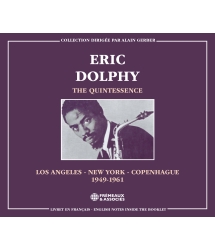
Eric Dolphy - The Quintessence
Los Angeles - New York – Copenhague 1949-1961
CD Version
€29.99
Digital Version
€19.95
Sonny Criss - 1947-1958
Selection d’Alain Gerber - Le volcan et la bougie
CD Version
€29.99
Digital Version
€19.95
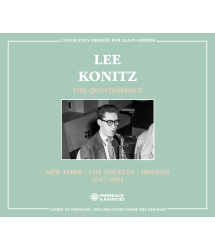
Lee Konitz - The Quintessence
New York - Los Angeles - Boston 1947-1961
CD Version
€29.99
Digital Version
€19.95